Unleash Diverse Voices: n8n Template Persona Content Workflow

We've all been there, right? Staring at our content pipeline, churning out article after article, only to realize... it all sounds a bit too much like us. Or worse, a single, unchanging entity, like a broken record player stuck on one note. Our content might be factually correct, but does it truly resonate with different audience segments? Does it have the spark, the specific tone, the unique voice that makes it stand out? Probably not, if we're generating it without a clear persona in mind. ✨
Today, dear developers, we're going to fix that! We're diving deep into building a robust n8n template persona content workflow that brings your content to life with distinct voices and dynamic templates. Imagine your content pipeline not as a monotonous factory, but as a vibrant theater, where different actors (personas) deliver compelling scripts (templates) tailored for every scene. Let's make our content truly speak to everyone! 🚀
The Content Director's Brain: A Mental Model for Personas
Think of your n8n workflow as a brilliant content director. When a request for new content comes in, this director doesn't just hand out a generic script. Oh no! They first identify who the content is for and what kind of voice it needs. Is it for the 'Tech Enthusiast' who loves deep dives and technical jargon? Or perhaps the 'Beginner' who needs clear, encouraging explanations? Once the persona is identified, the director then selects the perfect script template that matches that persona's style and the content's goal.
This is exactly what we'll build in n8n. Our workflow will dynamically route content requests based on a chosen persona, inject that persona's unique voice into the prompt, and then select from a pool of templates to ensure variety and relevance. It's like having an entire team of copywriters, each with their own specialty, working tirelessly for you!
This diagram illustrates our core concept: incoming content requests are directed by a Switch node to the appropriate persona branch, where a specific template is chosen, ultimately leading to a rich, persona-infused content output. It's a beautiful flow, isn't it? ✨
Deep Dive & Code: Building Our Dynamic Content Director
Let's get our hands dirty and build this system piece by piece in n8n!
1. Persona Routing with the Switch Node
First up, we need to guide our content requests to the right persona. The Switch node in n8n is perfect for this! It allows us to create different branches in our workflow based on conditions. We'll assume our incoming trigger (perhaps a webhook or a schedule) provides a persona field, like "persona": "tech_guru".
Here's how you'd configure a Switch node to route based on persona:
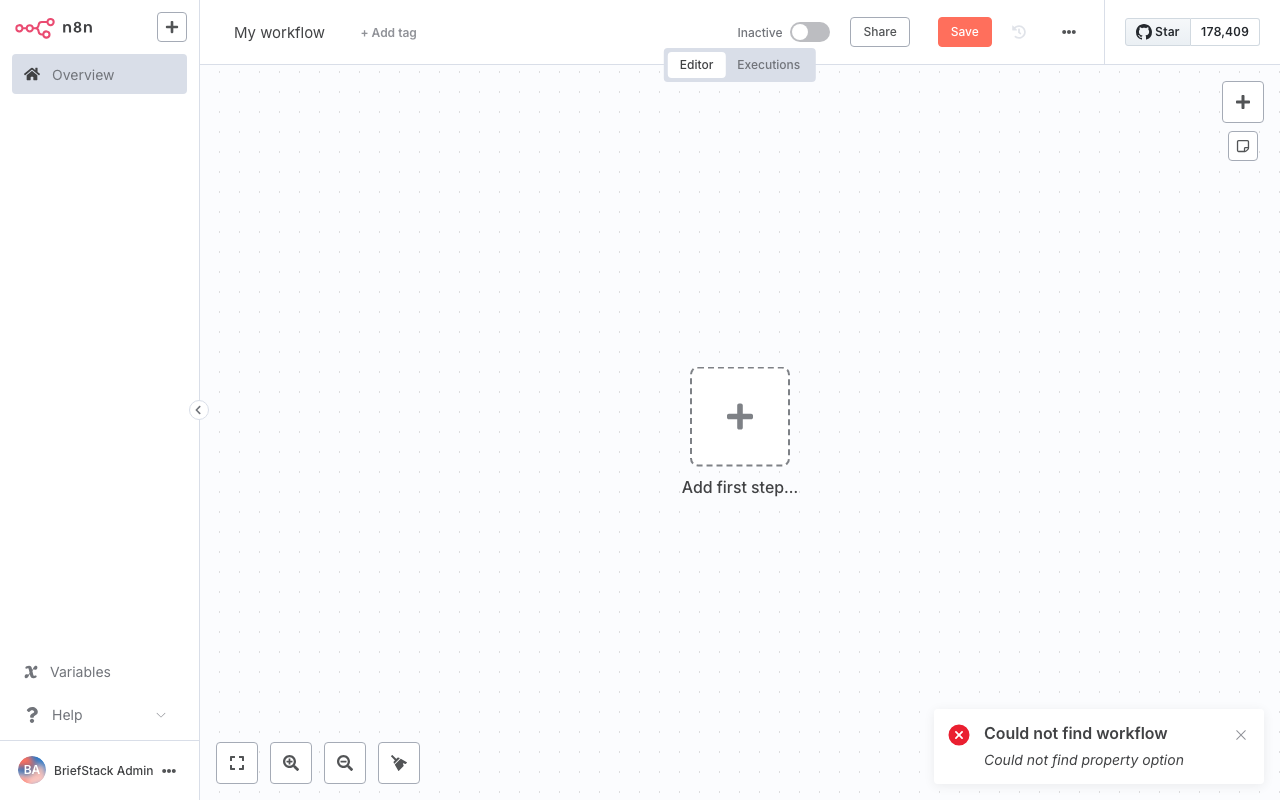
This screenshot shows a typical n8n workflow editor. You can see how nodes are connected, and the Switch node would fit perfectly after your initial trigger, directing the flow based on conditions.
In the Switch node, you'd add conditions for each persona:
[
  {
    "name": "Tech Guru",
    "value": "{{ $json.persona === 'tech_guru' }}"
  },
  {
    "name": "Friendly Explainer",
    "value": "{{ $json.persona === 'friendly_explainer' }}"
  },
  {
    "name": "Marketing Maven",
    "value": "{{ $json.persona === 'marketing_maven' }}"
  }
]
Why this is better: Instead of a long IF/ELSE IF chain in a Function node, the Switch node provides a visually clear and maintainable way to branch your workflow. Adding a new persona is as simple as adding a new branch, keeping your logic clean and easy to grasp at a glance. DX++! 💡
2. Storing Templates: Credentials vs. Static Data
Now, where do we keep our precious templates? We have a couple of excellent options in n8n:
- Static Data (Function or Set Node): Simple for a few templates directly within a workflow. Easy to see and edit directly in the node.
- n8n Credentials: Ideal for larger sets of templates, sensitive content, or templates you want to reuse across multiple workflows. This keeps your workflow canvas cleaner and promotes modularity.
PersonaTemplates) and store your templates as key-value pairs.
Here's a glimpse of the n8n dashboard, where you'd manage credentials and other global settings:
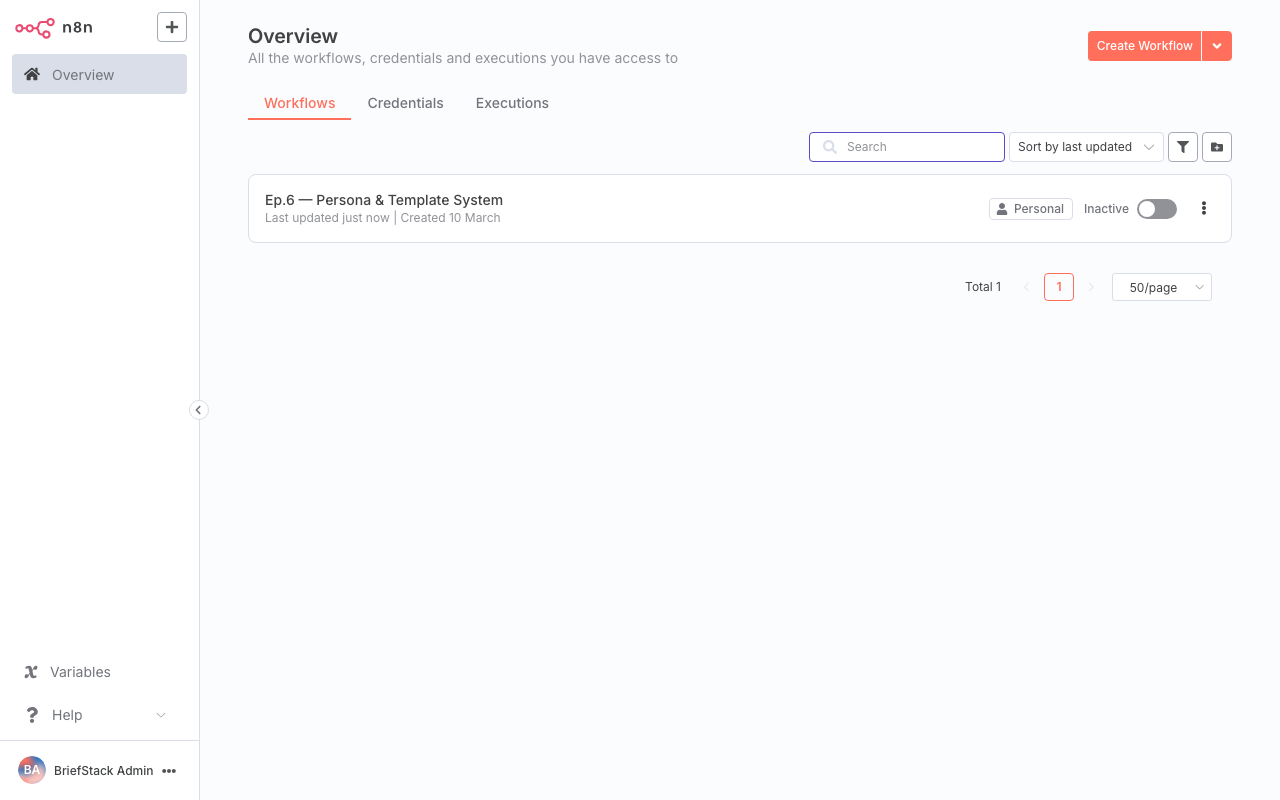
This dashboard view gives you an overview of your active workflows and allows you to navigate to crucial settings like Credentials, where you'd define your template storage.
Within your PersonaTemplates credential, you might have fields like:
techGuruTemplate1: "Dive deep into the asynchronous architecture of Node.js..."techGuruTemplate2: "Unpacking the nuances of React's Concurrent Mode..."friendlyExplainerTemplate1: "Let's gently explore how Node.js helps build fast web apps..."friendlyExplainerTemplate2: "Understanding React's magic for smoother user interfaces..."
Set node or Function node, you could retrieve a specific template:
// In a Function node, to retrieve a specific template for 'tech_guru'
const techGuruTemplate = $credential.PersonaTemplates.techGuruTemplate1;

return [
  {
    json: {
      selectedTemplate: techGuruTemplate
    }
  }
];
Why this is better: Storing templates in credentials declutters your workflow, making it much easier to read and manage. It also centralizes your content assets, so if a template needs updating, you do it in one place, affecting all relevant workflows. It's a huge win for maintainability and DX! 🚀
3. Injecting Persona Voice into Prompts
Simply selecting a template isn't enough. We need to infuse the spirit of the persona into our content generation. As we saw in Episode 5 with Gemini, the prompt is king! We can use a Set node or Function node to construct a dynamic prompt that incorporates the persona's characteristics and the selected template.
Let's say we have a personaDetails object (which could also be stored in credentials or a Set node) with descriptions for each persona:
{
  "tech_guru": "You are a highly technical expert who loves explaining complex concepts with precision and depth. Use advanced vocabulary and focus on implementation details.",
  "friendly_explainer": "You are a warm, approachable teacher who simplifies complex topics for beginners. Use analogies, avoid jargon, and maintain an encouraging tone."
}
Then, in a Set node after your template selection, you'd construct your prompt:
{
  "prompt": "{{ $json.personaDetails[$json.persona] }} Your task is to expand on the following topic, adhering to your persona's style: {{ $json.selectedTemplate }}"
}
Why this is better: This approach makes your content generation incredibly flexible. You're not just filling in blanks; you're giving the content engine a full personality brief! This leads to far more nuanced and engaging output, reducing the need for manual edits later. It's about working smarter, not harder. 💡
4. Weighted Random Template Selection
To keep our content fresh and prevent repetition, we don't want to use the exact same template every time for a given persona. Enter weighted random selection! This allows us to define a pool of templates for each persona and assign a 'weight' to each, making some templates appear more frequently than others.
This is best implemented in a Function node. For each persona branch, you'd have a Function node that contains the logic for selecting a template from its specific pool.
// Example for the 'Tech Guru' persona branch
const templates = [
  { content: "Explain the benefits of server-side rendering (SSR) in React, focusing on performance and SEO.", weight: 3 },
  { content: "Detail the process of setting up a CI/CD pipeline for a Node.js application using GitHub Actions.", weight: 2 },
  { content: "Discuss advanced state management patterns in large-scale React applications (e.g., XState, Zustand).", weight: 1 }
];

let totalWeight = templates.reduce((sum, t) => sum + t.weight, 0);
let random = Math.random() * totalWeight;

let selectedTemplate = templates[0].content; // Fallback
for (const item of templates) {
  if (random < item.weight) {
    selectedTemplate = item.content;
    break;
  }
  random -= item.weight;
}

return [
  {
    json: {
      selectedTemplate: selectedTemplate
    }
  }
];
Why this is better: This snippet is a game-changer for content variety. Instead of a predictable cycle, you get dynamic, fresh content that still adheres to the persona. The weight property gives you fine-grained control over how often certain topics or styles appear, ensuring your content strategy remains flexible and engaging. Your content will never feel stale! ✨
Performance vs. DX: A Win-Win Scenario
Let's wrap up our technical deep dive by looking at the holistic benefits of this persona and template system.
Performance Benefits:
- Consistent Quality: By standardizing persona definitions and templates, you ensure a baseline of high-quality, on-brand content, reducing the need for extensive human review and editing. This significantly speeds up your content pipeline.
- Reduced Manual Effort: The dynamic routing and template selection mean less human intervention in choosing the right voice or starting point for each piece of content. This frees up your team for more strategic tasks.
- Scalability: Easily add new personas or templates without overhauling existing logic. Your content generation system can grow with your audience and brand needs.
Developer Experience (DX) Benefits:
- Clarity and Maintainability: The
Switchnode provides a clear visual representation of your persona routing. Storing templates in credentials keeps your workflows clean and focused on logic, not content blobs. - Easy Iteration: Want to tweak a persona's voice? Update a template? It's a quick change in a centralized location, not a hunt through complex conditional logic.
- Empowerment: This system can even empower non-developers (like content strategists!) to contribute and manage templates directly in n8n's credential system, fostering collaboration and reducing bottlenecks.
- Reduced Cognitive Load: Developers can focus on building robust workflow logic, knowing that the content details are neatly organized and managed elsewhere. This means less debugging and more feature building! Who doesn't want to go home earlier? 🏡
Wrap-up: Your Content's New Personality!
There you have it! We've transformed our n8n content pipeline into a dynamic, persona-driven content powerhouse. By leveraging the Switch node for routing, intelligently storing templates, infusing prompts with persona voice, and implementing weighted random selection, your content is about to get a serious personality upgrade. No more monotonous monologues – only vibrant, targeted conversations with your audience! Your components are way leaner now, and your content is more engaging than ever. Happy Coding! ✨
Next up, we'll make sure our amazing content gets the visual flair it deserves by automating screenshot capture with Playwright! Stay tuned! 🚀
FAQ Section
Can I define personas directly within a Function node instead of using credentials?
Yes, absolutely! For simpler workflows or if your persona definitions are small and specific to a single workflow, you can define them as JavaScript objects directly within a Function node. However, for reusability and cleaner separation, credentials are often preferred.How do I handle a scenario where no persona is specified in the incoming data?
You can add a 'default' branch to yourSwitch node. This branch will catch any input that doesn't match your defined persona conditions, allowing you to either use a generic persona, log an error, or stop the workflow gracefully.What if I have many templates for a single persona? Does the weighted random selection scale?
Yes, the weighted random selection logic scales beautifully! You can add as many templates as you need to thetemplates array in your Function node. The logic will correctly calculate the total weight and select a template based on its assigned probability, ensuring variety regardless of the number of options.Can I combine persona and template selection with other dynamic elements, like A/B testing?
Absolutely! This system lays a fantastic foundation. You could introduce anotherSwitch node or a Function node to implement A/B testing after persona and template selection, perhaps by choosing between two slightly different prompt structures or final content tweaks for a specific persona. The modular nature of n8n makes this very achievable!